A Sense Of Perspective


Investors, regulators, analysts, fund managers, business journalists in the Asia Pacific region .... please take note:

1) The market cap of ExxonMobil, Procter & Gamble, Pfizer, Johnson & Johnson or Wal-Mart... just any ONE of them... is larger than the entire market cap of all companies listed on Jakarta Stock Exchange, or on Bursa Malaysia, or on the SES, or on the Thailand Stock Exchange.


2) The turnover of just ONE stock in South Korea, Samsung... for most days, is larger than the entire daily turnover of KLSE stocks.

3) About 85%-90% of all funds never match or outperform their respective benchmarks.

This blog is not meant to shame or embarrass, but rather a constant reminder to all investment pros in Asia, that we have to work harder in order to make a similar level of money. The scaling and leveraging in the US or much of Europe offers scaled salaries. If you manage ten M&A transactions in Asia-Pacific (except in China, I guess), it would not yield even half of one good size M&A transaction fees in the US.


Plus to those who scream and yell, why don't they invest in Asia-Pacific
... well, Asia-Pacific is so SMALL, if you are managing a US$500 million fund, you might allocate US$100 million to Asia - how many countries will you have to cover just to manage 20% of your portfolio. While on the other hand, I can cover 40% of my portfolio in US stocks and the other 40% in big European stocks. Somehow stocks listed in the big bourses in Europe tend more to act and look similar (e.g. London, Paris, Germany) but each exchange in Asia-Pacific is a different animal on it own and require more work to understand before acting.


Of course, this is not to belittle our jobs in Asia-Pacific. Far from that, we just need to get a better sense of perspective of what we do, where we are, and where are we headed. Be aware of the pond we are swimming in, be proud of the pond we are swimming in, but also know that there many other bigger ponds out there.

Lastly, don't take ourselves too seriously:

Q: What’s the definition of optimism? A: An investment banker who irons five shirts on a Sunday evening.

***

Q. What is the difference between government bonds and men? A. Government bonds mature.

***

An investment banker said he was going to concentrate on the big issues from now on. He sold me one in the street yesterday.

***

A man went to his bank manager and said: ‘I’d like to start a small business. How do I go about it?’ ‘Simple,’ said the bank manager. ‘Buy a big one and wait.’

***

The credit crunch is getting bad, isn’t it? I mean, I let my brother borrow a tenner a couple of weeks back, it turns out I’m now Britain’s fourth biggest lender.

***

Q: What is the difference between an investment banker and a pigeon?
A: A pigeon can still make a deposit on a BMW.

***

Q: What is the difference between an investment banker and a large pizza?
A; The pizza can still feed a family of four.

***

Q: What does a hedge fund manager with no fund to manage say?
A: Would you like fries with that sir?

***

Q: What is the capital of Iceland?
A: About $3.50

***
I tried to get cash from the ATM today but it said “insufficient funds.” I don’t know if that meant them or me.

***
Mark Twain: “October. This is one of the peculiarly dangerous months to speculate in stocks. The others are July, January, September, April, November, May, March, June, December, August and February.”

***

Once upon a time three people were stranded out at sea - A Japanese, a Malaysian and an Indonesian. The boat started leaking and if they do not act fast they would all die. The Japanese (as usual) was the first to take the initiative. He threw all his Japanese gizmo - CD player, hi-fi, radio etc. off the boat. The Malaysian and the Indonesian looked at him in disbelief. The Japanese said, “Don’t worry.. still got a lot more in my country.. BANZAIIIEE!”

But the boat was still sinking. The Indonesian without hesitation started throwing aboard all his baju batik, kain batik, keretek, etc., etc. He comforted the other two, “Don’t worry.. still have a lot more in my country, paknya”. But still the boat was sinking. The Japanese and the Indonesian looked at the Malaysian. Suddenly, without any hesitation and with stride, the Malaysian threw the Indonesian overboard. The poor guy couldn’t swim and drowned. The Japanese was shocked. Said the Malaysian, “Don’t worry… still got a lot more in MY country!!!”.

***


p/s photos: Marsha Timothi


Why Even Produce Oil When Its Below $40 (Revised)


Click on the link to get the latest breakeven oil price for major oil exporting nations. We do feel sorry for them, don't we?!! Summary:

2008 breakeven px / 2009 breakeven px
Bahrain $75 / $84
Kuwait $33 / $34
Oman $77 / $78
Qatar $24 / $24
Saudi Arabia $49 / $54
UAE $23 / $24
Algeria $50 / $60
Azerbaijan $40 / $35
Iran $90 / $90
Iraq $111 / $94
Khazakst $59 / $67
Libya $47 / $53

http://www.cnbc.com/id/27355967/


Venezuela depends on oil revenue for half of its public spending and more than 90% of its exports. It is the largest exporter in the Western hemisphere. The budget for 2009 was based on the assumption that oil price would be at $60. Can Venezuela stop exporting now that oil is below $40? The country is too reliant on the revenues. It cannot stop exporting as that would mean 90% of export revenue will be gone. Though Venezuela's cost of production might be on the lower side of $25, but the country is already too dependent on oil revenues.

Major flaw, the government did not invest oil proceeds properly over the last 20 years. If they used the bulk of funds by investing into education, infrastructure and broadening FDI base - now they would have moved up the economic ladder already instead of being primitive drillers-exporters with limited value-add industries.


Its the similar story for many of the oil exporters. The following countries also have a very reliance on oil as a percentage of total exports (2007 figures):
Algeria 98.5%
Libya 97.5%
Nigeria 88.3%
Russia 48.8%
Kuwait 95%
Saudi Arabia 89%
UAE 50.8%

Although oil prices have plummeted to below $40, most OPEC countries are still OK with it as the sharp correction has been counterbalanced by a 30%-60% depreciation in their own currencies vis-a-vis the USD. 14 out of 24 fuel exporters (where fuel is 50% of GDP or more) have a conventional peg to the US dollar, seven oil exporters peg to a basket of currencies including the US dollar and the euro or have a managed float regime, usually de facto targeting the US dollar and the euro. Three oil exporters in the CFA franc zone peg to the euro.

There is also geopolitics consideration. Kuwait, Saudi Arabia and UAE are "friends" of the US and would be more or less influenced by the Americans global strategy. Low oil prices are needed to bring about some support to stave off a global recession.

On the other side - Iran, Russia, Venezuela and Libya would be more inclined to pursue differing political ambitions. They are also more inclined to use oil proceeds to further exert their influence on "weaker nations" so as to support regimes aligned to their own interests. Its a generalised statement but has more truth to it that it appears. Hence Saudi Arabia would be more interested to have a lower oil price for now, one to help the global economy, two, to lessen the monetary might of the Iran, Russia, Venezuela and Libya - ceteris paribus, the latter 4 countries would have things a lot tougher than say Saudi Arabia, UAE or Kuwait with presnt oil price levels. That is also why the "rogue nations" will always be clamouring for OPEC to cut production to boot oil prices. We should be thankful that we have Kuwait, UAE and Saudi Arabia on the side of democratic nations.

Iran has the second largest known conventional crude oil reserves in the world, and it has used them in the past four years as a political and economic weapon to defy and undermine the West while promoting its own agenda. Oil money helped Iran spread its influence in Iraq. Oil money helped it challenge Arab political dominance in the Middle East. Oil money helped spread its influence in Lebanon, through Hezbollah, and in the Israeli-Palestinian conflict, through Hamas. IMF has stated that Iran would face unsustainable deficits if price of oil falls below $75. Iran now has to contend with 30% inflation and its economic status is now extremely fragile. Suffice to say that its political influence has be halted and its domestic economy is crumbling fast.

Russia was still willing to use its vast energy reserves to try to reassert the dominance it lost with the Soviet Union’s collapse.

If you look at the breakeven price for most countries, they are operating at a loss. Oil might be more valuable to be kept in the ground for many of the nations whose breakeven is more than $50 - but they cannot just stop all production: one, exports of oil make up 80%-90% of all export proceeds; two, you still have a substantive number of workforce dependent on the oil industry; three, there have been a lot of sunk cost, infrastructure and supporting industries built around the oil industry in their respective countries, long term supply contracts, etc. - switching things off will basically decimate and destroy the economy. Arabia’s king noted that they need $75 a barrel oil in order to meet their budgets and in order to open up new fields. That’s an important comment since they are the largest of the OPEC countries. Qatar and Kuwait only need $55 a barrel oil. However, even that is still 38% above the current price of $40 a barrel. Hence oil below $40 would result in a massive cutbacks in expenditures, investments, curtailing of seeking new oil fields, going into massive budget deficits, or a combination of these cited effects. In other words, the depressed oil prices actually will see a lot less reinvestment into new oil fields which will come back to bite us a few years down the road.

p/s photos: Lynn Hung Doi Lum

Some Caveats On KNM


Well, at least The Rock tried to explain his concerns over KNM. This does not represent my view, nor do I agree or disagree with his view as I have no way of ascertaining its validity. Thanks to The Rock. This will serve as a good exercise where a recommendation based on analyst reports and annual reports, and to see whether it can stand up to vicious rumours. I hope the SC will investigate these purported vicious rumours. Investing should never be like this - no one can/should base their investing on "inside gtrack information flow", the general public cannot be disadvantaged by such situations. If we cannot rely on publicly available information, if we cannot rely on analyst reports, if we cannot rely on independent auditors verification, if we cannot rely on them... how else should investors base their investing decisions on? Of course, if management decides to defraud (e.g. Transmile, Enron), it will be difficult to detect. At this point in time, I would still tend to side with my view that KNM is a vicitim of the oil plays being out of favour and that many foreign funds have sold down. All counters have influential substantial shareholders, they backing out is not out of the norm. KNM is also not that political a counter as its business model is acquisition/ EPS accretive strategy.

The Rock has left a new comment on your post "What's Shaking KNM":


I have been following KNM since early 2006. Made some small money. Recently I reviewed it again and asked around - what's happening to the price?
Well the inside news is a total shock to me. No analyst or newspaper have a clue to what is really happening in the company or to its financial backers.

While it's probably not going to be a Transmile, but the people[a few of them, not just one] who have dealings with KNM advised me to stay away from the company.
One of the worse thing that happened to them was that the promoter's strongest financial backer decided to pull the plug ! That's is when u see the share price started to crash ! It has nothing to do with foreign funds. This is a local guy.

Second is KNM overpaid for Borsig. When a PE firm sells you something you got to ask WHY WHY WHY ? It was done at almost the peak of the oil cycle. Any acquisitions done in 2007 or even 2006 will be costly to the buyers. Look at Rio Tinto now trying to swallow their USD38 bil debt for buying Alcan ! It can actually bring down Rio if they can't get refinancing or the economy gets worse from here.


The 3rd point is I was told KNM is linked to a political figure whose fortune has taken a turn for the worse since the March 8 general election. This point is related to the first point.


Don't ask me to reveal the names of the no.1 and no.3 guys. If you think what I say here is credible - good. If not - it's your problem.
I have bought Transmile shares before it crashed and suffered massive losses when the fraud was announced. Lesson learnt : when in doubt - don't touch.

They are so many other clean stocks/companies to buy/invest. Why bother with a stock just because it was the darling of the analysts, whom none have had business dealings with KNM !! My sources are people who actually have had dealings with them. It is not based on newspaper or desktop analysis.
You need to have an inside track in the current crisis before you jump in and put your money at risk. The low tide will expose more fraud.

MY advise - wait for a few more months and see if any more funny business surfaces. No point trying to jump in now hoping to catch at the bottom when we just don't know where and when is the bottom !
Just trying to be helpful...caveat emptor.

P/s photo: Amigo Feng

Setting Up For A Rally


Market fear gauge below 40 for first time since October
VIX 40.00, -1.63, -3.9%) , short for the Chicago Board Options Exchange Volatility Index, reached a low of 39.61 on Wednesday, a level unseen since Oct. 2. The VIX, based on a number of index options, shows the market's expectations for volatility over a 30 day period. According to FactSet Research, it spiked to record highs of between 81 and 96 in late October, as panic gripped markets worldwide. Since 2003, readings below 20 were the norm.


Roger Nusbaum:
As the world says goodbye to one of the worst years ever (for the markets), 2009 will be starting out with plenty of unknowns and fear.

I recently said the probability of a huge decline is a lot less right after a huge decline. That is where the world is now. The world is wading through the aftermath of a huge decline, trying to sort it all out. The way markets work, by the time it is all sorted out the market will be much higher.

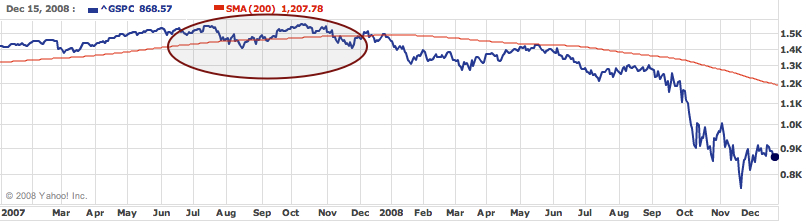
The S&P 500 went below its 200 day moving average (DMA) which is an important indicator for me, over a year ago:

When this happened, very few people heeded that warning. In fact, most were explaining to us why there would be no bear market or recession and selling stock was difficult for most folks. Now, buying stock has become difficult. More often than not, the difficult thing turns out to be the best thing to do.

I think we are setting up for a massive rally - much more than the 20% rallies we have had. The quicker a massive rally were to occur, the more likely I would expect it to turn out to be a bear market rally and I would look to add an inverse ETF as a hedge if the rally was very fast. 30% in a couple of months would be a scenario that I would fade. If the market rallied 30% over 12-15 months, I’d be less likely to fade that one - but that is a long time off.

While 30-40% might seem laughable, the biggest up years for U.S. markets that I know of occurred during the 1930s.

p/s photo: KC Concepcion

Buffett unfazed by Berkshire slump


Bloomberg: January 1, 2009 - 10:14AM

Billionaire Warren Buffett’s Berkshire Hathaway dropped 32% in 2008, the worst performance in more than three decades, as the recession forced down the value of the firm’s equity holdings and derivative bets.

Most of the stock decline happened in the last three months as Berkshire posted a fourth straight profit drop amid sagging insurance results. The company still beat the 38% tumble of the Standard & Poor’s 500 Index, the 14th year in 20 that Buffett outperformed the benchmark. Just six of 1596 US stock mutual funds with at least $US250 million in assets made money for investors this year, according to data compiled by Bloomberg.

''In 2008, there was nowhere to hide,'' said Guy Spier, chief investment officer at Aquamarine Capital Management, which holds shares in the Omaha, Nebraska-based company. ''What Buffett tries to do is ensure that Berkshire Hathaway does less badly than other companies.''

Buffett, 78, poured money into stocks as prices fell and increased Berkshire’s pace of deals as the contraction in credit markets hobbled buyout firms. Buffett spent about $US3.9 billion on equities in the third quarter, making Berkshire the biggest shareholder in ConocoPhillips, the second-largest US refiner. Berkshire announced 12 acquisitions in 2008, compared with eight in 2007, and also agreed to buy $US8 billion in preferred shares from Goldman Sachs Group and General Electric Co.

'Licking his lips'

''Buffett has the opportunity to do what he does best, which is acquire new companies at prices that have him licking his lips,'' said Frank Betz, a partner at Warren, New Jersey-based Carret Zane Capital Management, which holds Berkshire shares. ''I don’t think Mr. Buffett is bummed out at all.'' Jackie Wilson, a spokesman for Berkshire, didn’t return a call seeking comment.

But not all of his Buffet's bets have gone according to plan. Berkshire agreed in July to a $US3 billion investment in Dow Chemical Company to help finance its $USD15.4 billion takeover of Rohm & Haas. Dow shares plunged after Kuwait withdrew a deal to buy half its plastics unit for $US9 billion, prompting Standard & Poor’s and Moody’s Investors Service to cut the firm’s ratings.

Buffett’s deal called for the Dow stake to be convertible to common stock at a ratio that would put the investment in the money if the Midland, Michigan-based company’s shares exceed $US41.32 a share, which is more than twice the current price.

The investment ''is so far out of the money it won’t be profitable for years,'' Gene Pisasale, who helps oversee about $US13 billion at PNC Capital Advisors in Baltimore, said in an interview. He said the 8.5% annual payment on preferred shares seemed reasonable when the deal was struck. ''Since then, previously attractive yields now appear skimpy,'' he said.

Coca-Cola, Wells Fargo

Most of the top holdings in Berkshire’s stock portfolio, valued at $US76 billion as of September 30, have declined at least 15% in the past three months. ConocoPhillips plunged 29% in the fourth quarter. Coca-Cola, Berkshire’s top holding, dropped 14%, and No. 2 Wells Fargo & Company plummeted 21%.

Declines in the value of derivatives also pressured Berkshire shares. Buyers of the contracts would be entitled to billions of dollars from Berkshire if four stock indexes drop below agreed-upon levels on dates beginning in 2019. Buffett said the liability on the contracts was $6.73 billion at the end of the third quarter. Berkshire has collected $4.85 billion on the contracts and can profit from investing the funds, the firm said.

Derivative bets

All four indexes, including the Standard & Poor’s 500, would have to fall to zero for Berkshire to be liable for the entire $US35.5 billion that’s at risk, Buffett said in November. Acknowledging investor concern, Buffett has said he’d provide more information on how he calculates losses on the contracts.

The firm’s annual report for 2008 will disclose ''all aspects of valuation'' and cover ''deficiencies in the formula'' for pricing the derivatives, ''which we nevertheless use,'' Buffett said in an e-mail sent by an assistant in November.

Buffett built Berkshire over four decades from a failing textile maker into a $150 billion company by buying out-of-favor stocks and businesses whose management he deemed superior.

Berkshire gained $U4,600 today, or 5%, to $US96,600 in New York Stock Exchange composite trading. That compares with the $US141,600 closing price in 2007, when Berkshire advanced 29% for the year.

Berkshire’s 2008 stock slide is the worst since at least 1976, according to Global Financial Data, which keeps records on historical prices.

The stock plunge ''doesn’t make any difference,'' Buffett told Fox Business Network November 21.

''It’s happened to me three other times,'' Buffett said. ''It went down 50% in 1998-to-2000. I mean, I hope I live long enough so it happens a couple more times.''

p/s photo: Aum Patcharapa Chaichua


What's Shaking KNM


What could KNM be doing to defraud investors? Fraudulent contracts, artificial jobs, not being paid, raising up debtors as revenue, cancellation of work orders, margin calls on controlling shareholder if any, impairment in the goodwill of Borsig, etc...

KNM has been sold down owing to it being a oil infrastructure play. The stock will see great volatility as the controlling shareholder holds less than 25%, next being EPF with 7.7% on nearly 4bn shares. When a controlling shareholder holds less than 25%, one tends to be suspicious.

However if you look at KNM's business model, it is one built on acquisition and managing growth by integration. Purchases are often funded by issuance of new shares thus the huge free float. Safe to say that when markets tumble, the minority but substantive shareholders (of previously merged smaller companies) will tend to throw their shares. Its part and parcel of investing in KNM.


Fund managers love it and hate it, love it because its business model is scalable, hate it because its a thematic stock. Love it because it has very good free float, hate it because it has very good free float. When oil prices are high, its an excellent proxy, same on the way down.


A fraudulent company can be easily found out in international markets, its only when its a closed door thing like Madoff or the Enron case where only a few people move figures around that can lure many unsuspecting people. When you are international markets, you have to deal with fellow peers and it becomes hard to hide company's strategies and dealings. If you check with its global peers such as FMC Technologies and Cameron International, their stock price movements mirrors that of KNM.
The way KNM executes its strategy, via acquisitions, makes it even more cumbersome to do fraudulent things because there's always the "fair valuation exercise", "due diligence exercise", a seperate life before the acquisition, blah blah... you cannot really expect to overpay and do hanky panky without analysts whacking you.

The abortion of the purchase of Ellimetal NV for 20m euros shows good sense in recognising bad timing and recognising when the industry has turned. KNM has instead agreed to market Ellimetal's technology and products to KNM's Southeast Asian client base.


KNM's other aggressive planned expansion into mining for oil sands in Canada has been rightly halted. The tar sands is only profitable is price of oil is more than $85. Even if price of oil improves, a lot more strategic thinking and financial planning needs to be done before venturing into that sub sector.


Some concerns focused on the free cash flow and the enormous goodwill. One should look closely at their business model, which is acquisition by minimal cash but a lot of shares issuance, that in itself brings about a certain accounting character to lumpy items. When you do shares issuance acquisition, you want a profitable company with quality, predictable earnings - as the latter will be able to work down on the goodwiil or premium you are paying or else the share issuance program will work negatively thus destroying company value very quickly. In that sense one should appreciate KNM's strategy to buy very secure companies with secure earnings, but they also come with a price, which is usually a lot higher than book NTA, or else why would they sell to you. Its a corporate finance game which KNM plays relatively well. Their swift decisions to abort the oil tar sands and Ellimetal projects tells me that they know the game well, stop doing the acquisition tango when the trend is gone.

Sigh, KNM should hire me to do their corporate PR and institutional strategy relations... but it won't be cheap... and yes, I will take KNM share options ...lol.

Outstanding order in the books stands at RM4.3bn which is still 180% of revenue of the previous financial year. Assuming orders are zero for the next 6 months (while in actuality they are in bidding for over RM22bn of projects), and even if 20% of existing orders get cancelled, KNM is not going down the drain. That's because it has a very manageable net gearing of less than 20%.


The big danger I see is Borsig's RM1.6bn goodwill. KNM will have to ensure that Borsig is continually profitable in order to be able amortise that down over a certain period properly. If Borsig suddenly turns unprofitable, then yes, KNM is in the hell hole as that amounts to 90% of KNM's shareholder funds being wiped out instantly.


Part of KNM's rapid selldown a few months back was due to the forced selling of over 70m shares of Lee Swee Eng (the controlling shareholder) owing to the collapsed in share price and margin calls, and a subsequent selldown by Fidelity. The forced sale basically took out just 2% from Lee's stake, so its not catastrophic.


Its forward PE is at a ridiuclous 3x, even Ramunia has a higher PER. I like KNM because its a volatile stock with very good free float and will be a strong proxy on a recovery in oil prices. There are just less buyers on anything to do with oil stuff now, and KNM still has a relatively high level of foreign shareholders, nearly 30% which will dominate the price trends. I think a subtle recovery in oil will push KNM through this difficult period.

p/s photo: 2r

Wang Off


wang has left a new comment on your post "Portfolios According To Outlook For 2009":

it seems dali has no idea what is happening to KNM.. I wonder why he still recommends this counter among his top picks... You know what they say? share price never lies... dali, quickly retract ur call before its too late... hahaha... anyway, its a typical fund manager's blind favorite...sigh...

wang has left a new comment on your post "Portfolios According To Outlook For 2009":

check KNM account please... a fraud is brewing... dali...

Wang, if there is something you like to share, please do, but do not make statements without any elaboration. If there is a fraud brewing, please at least hint what it is all about. I could say that your mother is not a woman, and stop at that. That would surely piss you off, but if I offer some proof or logical deduction, you may thank me for it. Right now, I cannot thank you but feel a bit pissed off. Hope you understand, looking forward to your elaboration or deduction. Life is not always one smart person and the rest are idiots, so don't try to make yourself out as the one smart person. If someone wants to rip us off, we can only guard ourselves with publicly available information. We cannot be going around to their rigs and check that they are actually drilling, or pore through the books and confirm with their auditors, rig managers, technology officer, etc... that they are doing their job. Your comment about fund managers being typical idiots is also uncalled for, unless you justify or elaborate why buying this stock makes them a typical idiot fund manger. I will write about why I like KNM a bit later. Look forward to hearing from you.

p/s photo: Vivian Hsu