The "Must Read" Book Before You Vote At The Next Elections

Malaysia: Vision 2020 Road Map
By Koon Yew Yin

Preface
This book has been inspired by Vision 2020 and a speech given by Tengku Razaleigh eighteen months ago in Ipoh to the Perak Academy.  Following his lecture titled “The Challenge of the Present” I was motivated to write an article which subsequently appeared in a number of websites.  In my article which is reproduced in the book, I stated that I had discussed his speech with friends in the audience.  Those of us present at the meeting, and I am sure many other Malaysians, agree with Ku Li that the nation is in crisis and that “a rebirth of the ideals of the Rukun Negara; of diversity and unity” has never been more urgently needed than today.

In his speech, Tengku Razaleigh called for “a movement of peoples, intellectuals and political parties for a national consensus or compact which should include key political principles that can provide an important foundation for rebuilding our fragile Malaysian unity and solidarity.”   This book is a response to the call from a respected statesman and one of our most eminent political leaders for the urgent task of putting in place principles, ideas and ideals that can comprise the national consensus and compact necessary for our survival as a nation.  The book provides not only an analysis of how and why the old road map has failed us in some of the most critical aspects of life but it also outlines the new road map and the new directions needed to rebuild our fragile Malaysian unity and solidarity and move our country towards a progressive and cohesive society as envisaged in Vision 2020.    

Besides responding to Tengku Razaleigh’s call – a call which he has brilliantly and succinctly elaborated on in the foreword that he has kindly provided for the book -  my writing is also a  response to public concerns that the country is in danger of falling behind in reaching the 2020 timeline for achieving key goals and targets for the country’s development. When first introduced by Dr. Mahathir, the former Prime Minister, during the tabling of the Sixth Malaysia Plan in 1991, the vision called for the country to achieve developed nation status by the year 2020.   Although it was a plan which encompasses all aspects of life - from economic prosperity to social well-being to political maturity - it is important to note that the original 2020 plan gave equal if not more emphasis to the soft ware of development.  Hence the challenges outlined were not merely economic targets but also the less physically tangible goals of a society that is ‘psychological liberated and secure’, ‘democratically mature’, ‘liberal and tolerant’, ‘caring and progressive’, ‘moral and ethical’, ‘fair and equitable’ and ‘robust and dynamic’.   

                                               MALAYSIA’S VISION 2020 CHALLENGES

Challenge 1: Establishing a united Malaysian nation made up of one Bangsa Malaysia (Malaysian Race).
Challenge 2: Creating a psychologically liberated, secure and developed Malaysian society.
Challenge 3: Fostering and developing a mature democratic society.
Challenge 4: Establishing a fully moral and ethical society.
Challenge 5: Establishing a matured liberal and tolerant society.
Challenge 6: Establishing a scientific and progressive society.
Challenge 7: Establishing a fully caring society.
Challenge 8: Ensuring an economically just society, in which there is a fair and equitable distribution of the wealth of the nation.
Challenge 9: Establishing a prosperous society with an economy that is fully competitive, dynamic, robust and resilient.


How near or how far away are we from achievement of Vision 2020?  No less a person than Dr. Mahathir has expressed strong doubts on the ability of the country to attain the goal. Putting the blame on the economic crises that have hit the nation (1997/98 and 2008) in the two decades since the Vision was unveiled, Dr. Mahathir in a widely reported speech at the Perdana Leadership Foundation’s CEO Forum 2010 on 29 September, 2010, was pessimistic that the attainment of both economic and non-economic goals could be achieved. 

On the slow progress with achieving a united Malaysian nation or Bangsa Malaysia, he has explained that he had envisioned in 1991 that economic progress and general prosperity would be able to overcome race-based mindsets and concerns. However, talk of racial rights, privileges and opportunities, attributed partly to Malaysia’s more modest economic progress, and partly also to the fact that the government is not as “strong” as it used to be, has been taken advantage of and pressured by racial-interest groups according to Dr. Mahathir, and this in turn has undermined Vision 2020.  

During the Question and Answer session of his presentation, Dr. Mahathir elaborated on leadership and corruption – stating that Malaysia was in danger of having this moral turpitude move from “under the table” (a crime that needs to be hidden) to “above the table” (where corruption is accepted as the norm), unless the leadership takes strong action against graft.  The key twin issues of corruption and governance are given much attention in the book, although my diagnosis and proposed solutions in eradicating corruption and instilling good governance differs markedly from those that were pursued by Dr. Mahathir during his more than two decades of ruling the country.   

In addressing the concerns of Tengku Razaleigh and Dr. Mahathir, the book may be seen as a source of ideas and suggestions for the general public as well as for politicians and policy makers to whom the book is principally addressed.  It is intended to challenge them to think outside the conventional political box for the road map and solutions that can help the country get out of the vicious circle of narrow race and crony-ridden development that has damaged our present and future prospects.  

The book is also aimed at our Malaysian diaspora.  During my frequent trips abroad, I have come across many Malaysians who have emigrated in search of a better life and fairer opportunities.  These migrant Malaysians comprise a formidable and unique pool of talent and expertise that can enable us to attain our economic and developed nation status ambitions more quickly if they can be persuaded to return. I know that skepticism and cynicism is very prevalent amongst the community of émigrés, especially in relation to the Government’s commitment to a meritocratic and racially non-discriminatory society.  However I would like to urge them to come back so that Malaysia and they themselves can have another opportunity at making use of their special skills and entrepreneurship for the betterment of the nation.  
    
The book does not claim to any new or startling solutions or answers to the country’s problems.  In fact, it draws on some of my earlier writings on key issues and problems prior to and following the March 2008 elections which many, including from within the Government,   acknowledge as a watershed in the country’s political history.  Many of these commentaries on subjects such as the contracting industry, the New Economic Policy, Perak politics, educational development and others controversial issues of public concern have generated considerable feedback from readers in the web and blog sites where the commentaries initially appeared.  Some of these readers’ comments are reproduced in the book since they provide additional insights into the opinions and views of the concerned man-in-the-street on the subject matter of our future direction. 

In addition to the articles that have been written based on my own experiences and knowledge and some of the responses to them from interested members of the public, the book includes excerpts from the writings of various political leaders and personalities from a wide range of professions as well as key relevant excerpts of country analysis provided by national and international organizations.  The reason for inclusion of these materials – selected from a wide range of sources including published books and internet websites - is simple.  It is to acknowledge that many thinking Malaysians are equally concerned with the topics that form the subject matter of this volume just as I am.  There is much that is useful to be gleaned from uncensored and honest feedback not only in understanding the problems of the country but also in finding solutions if the Government and its policy makers have an open mind and are prepared to engage in open discourse and debate with a larger group of concerned citizenry beyond its own immediate coterie of supporters and consultants. I hope that in highlighting these non-conventional sources, which have been blanked out from the official media, this will encourage readers, especially from our political system and officialdom, to look outside the box for new wisdom to help resolve long standing problems.

When selecting the quotations and excerpts from the enormous literature available on the country’s recent development, the book has prioritized two types of directional materials:  one which can help us to identify and understand the wrong turns, detours and cul de sacs that have delayed or impeded our arrival as a fully developed nation; and two, materials related to the new strategies and processes that are needed to drive the country forward in attaining the goals and targets of Vision 2020. An extended statistical appendix has also been included so that the reader can have access to more neutral empirical data and trends of development found in important sectors of the economy and society. 

One of the key pointers as to how we are doing as a nation can be found in the large body of statistical material generated on practically every aspect of life today.  When reading the development literature available on Malaysia, I was shocked to find that the gap in our per capita standing compared with various neighbouring countries such as South Korea, Singapore and Taiwan - which were at more or less at the same level as Malaysia in the 1970s - had widened tremendously during the last 30 years. According to the 2009 data, our per capita income stands at US$7,468 compared with South Korea’s US$16,450; Taiwan’s US$15,373 and Singapore’s US$34,346.  This enormous difference shows how far we are lagging behind countries which are less well endowed and how past policies have served us badly.  As the statistical data comes from official international sources there is no reason to doubt it.

More than 20 statistical tables have been included in this volume ranging from economic aspects to governance and human resource development.  They offer a worrying – in some ways, alarming – confirmation of the lack of progress made not only in per capita income but also in diverse areas of education, race relations, religious harmony and economic growth.  Despite the drawbacks that are associated with over-reliance on statistical data, the statistical tables provided here offer a wealth of empirical data for policy makers and politicians to digest, especially for those who are still stubbornly clinging to their belief that the country has made immense strides in reform and change, and is progressing well.   The statistical evidence which provides a contrary of this rosy picture is just too compelling to ignore.

To ensure a more inclusive selection and to avoid charges that this is a politically partisan road map, readers will note that materials have been culled from both sides of the political divide.  No party in the country – neither from the Barisan or Pakatan side - has a monopoly on knowledge or understanding of the complex issues of development or of the challenges that have and continue to bog us down.  Besides my own work, preference in the selection has been given to assessments emanating from the younger generation of Malaysians as well as to those voices that have been marginalized or neglected by the official and mainstream media.  Some of these voices are of ordinary Malaysians writing under pseudonyms in response to the articles that I have written.

It is necessary to point out that one of the main intentions of the book is to show that whilst the national consensus and compact for national unity and solidarity may appear to be “an impossible dream” or “a distant rainbow” as sometimes lamented by my friends, there is at the same time a commonality that is discernible in terms of our understanding of the dangerous path of development that lies ahead and the pitfalls that we have to avoid if we are to ensure our future progress and prosperity.  This commonality of knowledge of the broad configuration of the country’s weaknesses and problems in governance, economy, social cohesion and race and religious relations is - in fact - shared by both Barisan Nasional government and Pakatan Rakyat opposition parties as well as by independent commentators and analysts.  It has, however, been obscured and overlooked in the hectic political posturing and politicking that has been prevalent during the last three years.

Not only is there a growing convergence in the analysis of what is ailing our society and its politics and economy but there is also a higher level of tacit agreement on what is needed to get the country moving again than is publicly conceded to by politicians. Of course, the extremists and ethno-nationalists will continue to engage in new stunts aimed at dividing our nation but we should not be distracted from our common purpose of achieving Vision 2020. It is my hope that by rising above the angry rhetoric and emphasizing this commonality of knowledge and views on key aspects of the country’s development, the book can play a bridging role in reconciling bitterly opposed political camps towards the same mission goal which is to galvanize the country out of the doldrums.  

Finally, this book is dedicated to the younger generation of Malaysians who will bear the main brunt of efforts in building our nation to its full potential as well as will have to pay the price of whatever failure or failings in reaching Vision 2020.   Hopefully, the road map provided by this book will make the path to our brighter and sustainable future clearer and easier to pursue.  

 FOREWORD
By Tengku Razaleigh Hamzah
It gives me great pleasure to provide a foreword to this important book.
Mr. Koon, the author, is no ordinary Malaysian. He is the founder of IJM
Corporation, Gamuda Bhd. And Mudajaya Group Bhd. – three publicly
listed companies – but is presently retired from business. I am happy to
know that he has now turned his attention to philanthropy and also that his
generosity has benefited various causes, especially in the educational field.
This has led him to be chosen as one of five Malaysians in a select list of 48
Asians honoured by the prestigious magazine, Forbes Asia, as “Heroes of
Philanthropy” in its annual list for last year.

As this book shows clearly, Koon is also a frequent commentator on socioeconomic
and political developments in the country. Mr. Koon writes with
perceptiveness and candor as well as with the voice of experience – qualities
that are often missing in the writings of many political analysts that are
provided with space in the mainstream media.

Mr. Koon’s writings have mainly appeared in the internet media and
it is timely that they now appear in print and are made available to a wider
public. I recommend that politicians on both sides of the political divide in
the country pay attention to the book. In this collection, he shares many of
my concerns on the future of the country and on the need for our leaders to
dedicate themselves to a Malaysia that is fair, just, balanced and cohesive. I am
honoured that my work and writings have served as a catalyst to this book. In
particular, I am gratified that his work also highlights a critical issue which
I have repeatedly stressed – that is, the importance of ordinary Malaysians
reclaiming our rights as citizens if we are to achieve our individual and
collective potential.

This process of empowerment and simultaneous rejection of leaders who
regard power and authority not as positions of trust and responsibility but to
serve personal interest or as an opportunity for personal enrichment will be
necessary if Malaysia is to prosper and move ahead to join the modern and
progressive nations of the world.

Tengku Razaleigh Hamzah

The Times Are A' Changing

Back in the early 1900s, when people talk about enjoyment, excesses of life (for guys, ..yes sexual bias) ... it was "wine, women and song". Funny though, they'd probably be drinking not so fine wines then but everything's relative. Women are women la. Song is more live cabaret singers as vinyl and radio weren't so prevalent then. That was the mantra for a hedonistic, indulgent behaviour.

The pleasure-seeking mantra wasn't an English invention. Similar tripartite mottoes have existed for a long time in many languages, for example:
Bengali/Hindi/Sanskrit – "Sur, Sura, Sundari" (music, wine and woman)
Bulgarian – "Пиене, ядене и някоя сгодна женица" (drink, food and a good woman)
Czech – "Víno, ženy a zpěv" (wine, women and singing)
Danish – "Vin, kvinder og sang" (wine, women and song)
Finnish – "Viini, laulu ja naiset" (wine, song, and women)
German – "Wein, Weib und Gesang" (wine, woman and singing)
Italian – "Bacco, tabacco e Venere" (Bacchus, tobacco and Venus)
Persian – "Kabab, Sharab va Shabab" (meat, wine and youth)
Norwegian – "Piker, vin og sang" (women, wine and song)
Polish – "Wino, kobiety i śpiew" (wine, women and song)
Swedish – "Vin, kvinnor och sång" (wine, women and song)
Spain – "Naipes, Mujeres y Vino, Mal Camino" (cards, women and wine, bad ways)
Portuguese – "Putas e vinho verde" (whores and green wine)


I like the Italian one, which had tobacco, or in my case, cigars, and the Italians sure know how to put such things in wonderful words: Bacchus, tobacco and Venus. How to top that?


Persians have "meat, wine and youth" .... hmmm, interesting. Portuguese are so direct: "whores and green wine", I wonder.


The phrase "wine, women and song"  may have also originated with the following couplet:
"Who does not love wine, women and song / Remains a fool his whole life long." Variations on this quote have been attributed to Martin Luther (not the 1960s Martin Luther), although Bartlett's Familiar Quotations names Johann Heinrich Voss (1751–1826) as a more likely source.


The waltz "Wine, Women and Song" (Wein, Weib und Gesang) is Op. 333 (1869) of Johann Strauss II had also been cited as a root influence.

The 70s
Moving into the 60s and 70s, "wine, women and song" seemed so outdated and passe. The mantra morphed into "sex, drugs and rock n roll". The earlier phrase was sexist as "women" were objectified and neglected. The rise of feminism, peace and equal rights movement probably caused the mantra to be changed.


Though "sex, drugs and rock n roll" started in the 60s, the phrase wasn't coined till Ian Dury wrote the song "Sex, Drugs and Rock n Roll" in 1977. The phrase truly captured the turbulent and mind changing 60s and 70s. The shift in generational gap has never been wider. Older folks could not comprehend what the younger set was trying to do with their lives.


Know what, the Ian Dury's song is still pretty good sounding.


Anyone want to try and recoin the mantra for the present days???

Shanghai Index Shaming China's Government?

This is uncanny. Can this be tweaked? Now there should be a big crackdown to look for "culprits".
Coincidence ... China's share benchmark fell 64.89 points on Monday, matching the numbers of the June 4, 1989 Tiananmen Square crackdown.

China's share benchmark has fallen foul of the country's internet censors by appearing to mark the 23rd anniversary of the Tiananmen Square crackdown on pro-democracy protesters.


In an unlikely coincidence certainly unwelcome to China's communist rulers, the stock benchmark fell 64.89 points on Monday, matching the numbers of the June 4, 1989 crackdown in the heart of Beijing.


In China's lively microblog world, 'Shanghai Composite Index' soon joined the many words blocked by internet censors.


Coincidence ... China's share benchmark fell 64.89 points on Monday, matching the numbers of the June 4, 1989 Tiananmen Square crackdown. 


In another odd twist, the index opened Monday at 2,346.98. That is being interpreted as 23rd anniversary of the June 4, 1989 crackdown when read from right to left.


Public discussion of the Tiananmen crackdown, which the Communist Party branded a "counter-revolutionary riot", remains taboo. Analysts refused to comment on the numbers.


On the popular Sina microblog site, searches using 'June 4', '64.89', 'stock market', and 'benchmark Shanghai Composite Index' were all blocked.


Such searches draw the response: "According to law such words cannot be shown."


In Beijing, the anniversary passed without any major sign of protest. The front page of the party newspaper, People's Daily, trumpeted the "Stable, fast development of the Chinese economy: Advancing to be the World's No.2".


The melee as soldiers fought their way into Beijing to clear Tiananmen Square is believed to have left hundreds dead. In response to the violence in the capital, demonstrations erupted in more than 180 cities.


Foreign Ministry spokesman Liu Weimin objected to a US State Department call for a reconsideration of the party's stance as "rude interference in China's internal affairs".


In the semi-autonomous Chinese city of Hong Kong, tens of thousands crowded into a large park to mark the anniversary. They held aloft white candles that transformed the area of soccer pitches into a sea of light, before observing a minute of silence.


Read more: http://www.smh.com.au/business/world-business/china-stock-index-evokes-tiananmen-with-6489point-fall-20120605-1zsoe.html#ixzz1wsgdYT8w

Commodities Correction - Something Sinister In The Works?

We can all appreciate stock markets correcting with the E.U. crisis somehow managing to find more things to worry about. However, the smarter ones would have been asking why the commodities have been falling way before stocks, and now seems only going stronger in its downfall together with global equities. 


Commodities have been a good gauge of the strength of economic recovery. Hence are we saying the global economy is headed for a tailspin? A minor correction is understandable but the way they have been correcting implies there is something graver in the works. 


Price of oil has fallen into a hole, so much so that it is below some of the OPEC members' production cost even. Other commodities have done likewise. What was interesting was that although gold did perk up, it did not reflect a stampede to get out of all assets with the fear of inflation in mind.


The negative yield into German papers indicate that people are rushing to solid currencies. Before we venture further let's look at the 2011 asset class returns. Almost everything went into a hole except for bonds, corn and oil. Hence we cannot say there had been any over exuberance over the past 18 months.  


2011 Sector PerformancePerformancePotentially Similar ETF
Utilities13.10%(XLU)
Healthcare10%(XLV)
Services4.20%n/a
Consumer Goods2.60%(XLP)
Technology-3.60%(XLK)
Conglomerates-3.90%n/a
Indusrial Goods-4.90%(XLI)
Basic Materials-10.40%(XLB)
Financials-18.80%(XLF)
2011 Capitalization PerformancePerformancePotentially Similar ETF
Large-4.40%(SPY)
Mid-4.60%(MDY)
Mega-6.60%(DIA)
Nano-8.30%n/a
Small-9.10%(IJR)
Micro-16.10%(IWC)
2011 Index Price PerformancePerformancePotentially Similar ETF
S&P 500-0.02%
Shanghai-22.42%(FXI)
Nikkei 225-17.34%(EWJ)
Hang Seng Index-19.27%(EWH)
Euro Stoxx 50-18.41%(FEU)
S&P/TSX Composite Index-11.01%(EWC)
2011 Currency PerformancePerformancePotentially Similar ETF
EUR/USD-1.30%n/a
USD/JPY-5.91%n/a
USD/CAD1.64%n/a
USD/CNY-4.62%n/a

Note: currency ETFs do exist, but without detailed explanation of how they work I thought it prudent to leave out the tickers.
2011 Commodity PerformancePerformancePotentially Similar ETF
Gold10.19%(GLD)
Oil6.33%(DBO)
Natural Gas-42.21%(GAZ)
Silver-9.75%(SLV)
Copper-19.56%(JJC)
Wheat-23.89%(JJA)
Soybeans-5.81%"
Corn15.43%"
2011 Bond ETF PerformancePerformanceETF Used in Calculation
Long Term US Treasuries30.25%(TLT)
iShares Aggregate Bond Fund4.68%(AGG)
TIPS9.28%(TIP)
Investment Grade5.17%(LQD)
High Yield-0.78%(HYG)


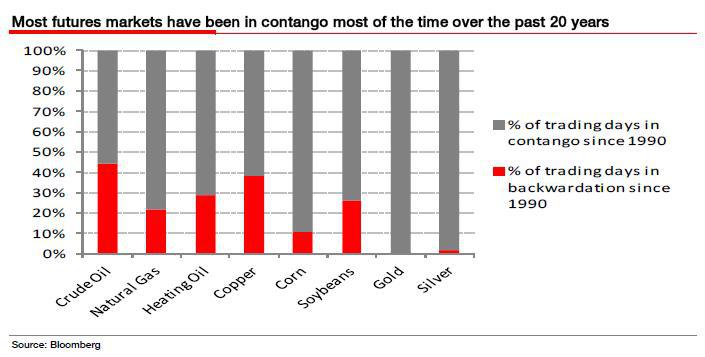
The Contango Effect
Malaysian market players from the 90s would be well aware of the word contango. Say you buy shares with minimal deposit or no deposit for say RM100,000 and you have no bloody intention of picking them up, or have the ability to. You have to rollover, that's contango. In the futures markets for commodities, a substantial portion of trades are contango trades.


A simple explanation for the commodities price fall would be that investors and traders have given up rolling over positions and just squaring. Generally in contango trades, you are usually long. It is infrequent that contango trades being short trades. Many hedge funds or large investors do contango trades because of the "super cycle theory", which Jim Rogers is famed for, i.e. we are supposedly on a very long bull run for commodities.

There are probably contributing factors to the diminishing contango positions: more ideal weather patterns for agriculture products (a weakened La Nina), a genuine reassessment that the China engine may not be as strong as first thought. Lump that in with the renewed E.U. crisis implosion (European elections), you have a potent mix.


Final Word - I do not think this is developing into a catastrophic scenario. I believe the correction in commodities is more a congruence of factors aligning itself at the same time. Nothing much to do but sit and wait. 

Decisions Made When At The Edge Of A Cliff

No, this posting is not about my personal love life, though it can be. Its about the Euro crisis and now we seem to have a probable way to get out of jail. Despite all the goodwill and financial measures to shore up Greece, it looks like Greece will have to leave. Spain, Portugal, Italy do not want that to happen as it could trigger new fears about their own impending exits.
 

Spain, the latest combat zone in Europe's long-running debt wars, urged the euro zone to set up a new fiscal authority to manage the bloc's finances and send a clear signal to markets that the single currency project is irreversible.


Prime Minister Mariano Rajoy said the authority would also go a long way to alleviating Spain's woes which, along with the prospect of a Greek euro exit, have threatened to derail the single currency project.


Sitting as Spain does on an estimated €220 billion, or about $273 billion, in failed real estate loans alone — a number that surpasses the entire output of the Greek economy — there is little doubt that Spain, with the fourth-largest euro zone economy — behind Germany, France and Italy — is too big to fail. Or, more precisely, to be allowed to fail. 


Analysts guess that a comprehensive rescue for Spain would cost €350 billion, and one for Italy would cost even more. Sums that large would quickly overwhelm the €500 billion available in the new European rescue fund, the European Stability Mechanism.


Indeed, many investors and money managers now see Europe’s challenge as not how to bail out sickly Spanish banks, but how to keep Spain and even Italy afloat and in the euro zone as money keeps leaving these countries, forcing interest rates up and leaving flaccid local banks as the only buyers of government debt.


It is not the first time a European leader has proposed creating such an authority but the problems and the size of Spain - a country deemed too big to fail - have prompted EU policymakers to hurriedly consider measures such as creating a fiscal and banking union ahead of a EU summit on June 28-29.


Analysts estimate that the amount needed to backstop failing Spanish banks is €60 billion to €80 billion, which on the face of it could come from Europe’s rescue fund.


The sticking point is that Spain wants Europe to inject money directly into these banks, as in the bank-bailout program in the United States in 2008 and a similar effort by the British government.


Germany, however, has no desire to swallow the bill for Spain’s bad banks, so it is insisting that funds be disbursed to the Spanish government and that strings be attached. It wants more draconian spending cuts and perhaps even losses for the mostly Spanish investors who hold the stocks and bonds of these failed banks. But as Berlin and Brussels butt heads with Madrid over who pays what, when and how, money continues to flee from Spain at an alarming rate. According to figures from the Spanish central bank, €66 billion left the country in March as investors sold Spanish stocks and bonds with abandon. And in April, the outflow of deposits from Spanish banks also picked up, with €31 billion leaving the Spanish banking system, according to the European Central Bank.
On consecutive days last week, two of the most powerful figures in Europe — Mario Draghi, president of the European Central Bank, and Olli Rehn, the most senior economic official in Brussels — warned that the future of the euro zone was in doubt. In the words of Mr. Rehn, the union might well disintegrate unless policy makers took steps to bind the euro’s 17 nations closer together.
Germany, the paymaster of the euro zone, and others insist such a move can only happen as part of a drive to much closer fiscal union and relinquishing of national sovereignty.
Overspending in the regions and troubles with a banking sector badly hit by a property crash four years ago have sent Spain's borrowing costs to record highs and pushed the country closer to seeking an international bailout.


The risk premium investors demand to hold Spanish 10-year debt rather than German bonds rose to its highest since the launch of the euro - 548 basis points - on Friday.

The Spanish government, which has hiked taxes, slashed spending, cut social benefits and bailed out troubled banks, argues that there is little else it can do and the European Union should now act to ease the country's liquidity concerns.


In private, senior Spanish officials have said this could be done by using European money to recapitalize directly ailing banks or through a direct intervention of the European Central Bank on the bond market.

The head of the World Bank yesterday warned that financial markets face a rerun of the Great Panic of 2008. On the bleakest day for the global economy this year,  Robert Zoellick said crisis-torn Europe was heading for the ‘danger zone’.


Mr Zoellick, who stands down at the end of the month after five years in charge of the watchdog, said it was ‘far from clear that eurozone leaders have steeled themselves’ for the looming  catastrophe amid fears of a Greek exit from the single currency and meltdown in Spain.

The flow of money into so-called ‘safe havens’ such as UK, German and US government debt turned into a stampede last week. In Berlin the two-year government bond yield fell below zero for the first time, with the bizarre result that jittery international investors are now  paying – rather than being paid – for lending to Germany.


The European Union itself is like a bubble. In the boom phase the EU was  unreal but immensely attractive. The EU was the embodiment of an open society –an association of nations founded on the principles of democracy, human rights, and rule of law in which no nation or nationality would have a dominant position. 
The Euro crisis must be solved...fast!

The process of integration was spearheaded by a small group of far sighted statesmen who practiced what Karl Popper called piecemeal social engineering. They recognized that perfection is unattainable; so they set limited objectives and firm timelines and then mobilized the political will for a small step forward, knowing full well that when they achieved it, its inadequacy would become apparent and require a further step. The process fed on its own success, very much like a financial bubble. That is how the Coal and Steel Community was gradually transformed into the European Union, step by step.


Germany used to be in the forefront of the effort. When the Soviet empire started to disintegrate, Germany’s leaders realized that reunification was possible only in the context of a more united Europe and they were willing to make considerable sacrifices to achieve it.  When it came to bargaining they were willing to contribute a little more and take a little less than the others, thereby facilitating agreement.  


The process culminated with the Maastricht Treaty and the introduction of the euro. It was followed by a period of stagnation which, after the crash of 2008, turned into a process of disintegration. The first step was taken by Germany when, after the bankruptcy of Lehman Brothers, Angela Merkel declared that the virtual guarantee extended to other financial institutions should come from each country acting separately, not by Europe acting jointly. It took financial markets more than a year to realize the implication of that declaration, showing that they are not perfect. That statement can be regarded as what set the current Euro crisis into a tailspin. When you are in a union, but your financials are largely your own business but not the union, you get yourself into loads of trouble, as you all have the same currency (i.e. interest rates).

This is a really huge point to grasp, because a nagging question has been: Why did the market think of Spain/Greece/Italy/Etc. as being risk-free sovereigns at one point, and then decide that they were not risk free and subject to credit risk.


Soros answer: Because they were essentially risk-free so long as the arc was always towards more integration. That ended when Merkel made the declaration above. The Maastricht Treaty was fundamentally flawed, demonstrating the fallibility of the authorities. Its main weakness was well known to its architects: it established a monetary union without a political union. The architects believed however, that when the need arose the political will could be generated to take the necessary steps towards a political union.


But the euro also had some other defects of which the architects were unaware and which are not fully understood even today. In retrospect it is now clear that the main source of trouble is that the member states of the euro have surrendered to the European Central Bank their rights to create fiat money. They did not realize what that entails – and neither did the European authorities. When the euro was introduced the regulators allowed banks to buy unlimited amounts of government bonds without setting aside any equity capital; and the central bank accepted all government bonds at its discount window on equal terms. 
Kipper Williams cartoon 4 October 2011
Commercial banks found it advantageous to accumulate the bonds of the weaker euro members in order to earn a few extra basis points. That is what caused interest rates to converge which in turn caused competitiveness to diverge. Germany, struggling with the burdens of reunification, undertook structural reforms and became more competitive. Other countries enjoyed housing and consumption booms on the back of cheap credit, making them less competitive. Then came the crash of 2008 which created conditions that were far removed from those prescribed by the Maastricht Treaty. Many governments had to shift bank liabilities on to their own balance sheets and engage in massive deficit spending. These countries found themselves in the position of a third world country that had become heavily indebted in a currency that it did not control. Due to the divergence in economic performance Europe became divided between creditor and debtor countries. 


In the end its Merkel with Bundesbank that will make or break the Euro crisis. We need Germany to show leadership and preserve the European Union as the fantastic object that it used to be. The future of Europe depends on it.


Over the weekend, German Chancellor Angela Merkel is pressing for much more ambitious measures, including a central authority to manage euro area finances, and major new powers for the European Commission, European Parliament and European Court of Justice. She is also seeking a coordinated European approach to reforming labor markets, social security systems and tax policies. 

Until states agree to these steps and the unprecedented loss of sovereignty they involve, the officials say Berlin will refuse to consider other initiatives like joint euro zone bonds or a "banking union" with cross-border deposit guarantees - steps Berlin says could only come in a second wave.


The goal is for EU leaders to agree to develop a road map to "fiscal union" at a June 28-29 EU summit, where top European officials including European Council President Herman Van Rompuy will present a set of initial proposals.


European countries would then put the meat on the bones of the plan in the second half of 2012, several European sources have told Reuters, including a timetable for overhauling EU treaties, a step Berlin sees as vital for setting closer integration in stone.
Caricature and Cartoon of Angela Merkel, the German Chancellor restrained from acting in the Eurozone crisis - A portrait and a sketch.
If European countries go ahead, the steps would represent the most significant policy leap since they agreed to give up their national currencies and cede control over monetary policy 13 years ago. But the hurdles are daunting. If they can, and they must, come up with a viable "banking union", that would SAVE the rest .... whether Greece will exit or not is not such a major issue anymore.


But, we will be watching what E.U. does best, serving up 3 weeks of fantastic competitive football.  Not supporting Spain this time around, I will be rooting for the Czech Republic this time. They are the underdogs as the likes of Smicer, Pavel Nedved, Marek Jankulovski, Karel Poborsky and Jan Koller are long gone, ... watch for Petr Jiracek and Vaclav Pilar.

Capturing That Late Night Feeling ........

Music, played right, will evoke images from an era that we might not even have lived in before. Memories can be based on real events, somehow some memories can be concocted from movies, magazines, photos as well. Possibly the finest jazz pianist in Malaysia, Tay Cher Siang, has conceptualised such a delicate album. It needed the voice of Yudi to bring forth such intoxicating "memories".


p/s in case you were wondering, the photo is not chersiang n yudi ..


The music can mean many things to you. Just the piano caressing the gentle notes, with just one mature voice ... speaks of late nights at old shanghai jazz bars, past midnight as the place is about to close, with the last few patrons sitting around for one last song. Cigarette smoke (or cigar smoke for me) wafting in the air, even the smoke wafts at the same slow speed as the tempo of the songs. Its perfect yet in a dimly lit place its perfectly un-perfect and temporary. Its exactly the temporary that causes this wonderful congregation of factors to be even more worthwhile and intoxicating. Nursing your last whisky ... aahhh... with nowhere to go ...


Look for the album "Shades of Passion", one voice, one piano ....