Showing posts with label Bank of America. Show all posts

Next Market Catalyst - Banks Stress-Test Results

The next catalyst for the US markets has to be the government's stress-testing of banks' results. Most analysts and commentators can only guess what the parameters are like. Some banks will be asked to raise additional capital due to the results of the stress-test.


19 banks were asked to submit to the test. If we look at the table for comparison, their Tier-1 capital would be a start. Those around 10% or below would fall under the "danger list", but its not all definitive, its probably one of the many factors that the government looks at. But Wells Fargo, Bank of America, even American Express and PNC Financial would fall under the "to be watched" category.


Of greater importance will be the Tangible Common Equity Ratio which has been harped on by Bernanke and Geithner. I think this measurement will be more critical. I would worry if the ratio is 4% or lower. Bank of America stands at just 3.1%. Citigroup is making me nervous at 1.7%. PNC Financial is there again at 3.3%, and US Bancorp is also there at 3.7%. Wells Fargo, despite registering such wonderful profits is there at 3.3%.


I think those that are below 4% will be barred from returning TARP funds back to the US government. Which is to say the Bank of America and Wells Fargo will still stay under the "jurisdiction of the US government" and will have to toe the line a lot more when it comes to compensation matters.


JP Morgan and Goldman Sachs are in the clear, and Goldman can return the funds should they wish. Returning the funds would allow Goldman to soothe executive nerves on drastic changes to their compensation scheme, and may act as a buffer to retain and attract talent in this difficult environment.


Even if Bank of America and Well Fargo may be asked to raise more capital. It is not a death sentence. It could just mean that these banks will have to try to convert existing preferred shares into common stock. We have to remember that when Citigroup did a similar announcement of the plan, it rocked the share price of Citigroup.
The blessings of the stress-test is that it will make more transparent the health of major US banks. Even though some may be asked to raise more common equity capital, the general view should be more of a relief to investors that these banks are continually being subjected to more screenings and testing of their viability. The end result of the stress-test is probably a boost to confidence and may actually see banking stocks moving up higher in tandem.


[stress tested]


In February, the Obama administration said 19 bank holding companies with more than $100 billion of assets would have to undergo a stress test. The move was designed to calm fears about the solvency of the banking system. The exams, conducted by more than 150 federal regulators, analyzed potential losses from residential mortgages to complex securities products. Banks will have several days to challenge the findings before the government makes results public the week of May 4.


p/s photos: Janice Man Wing Shan (a model turned actress, she will be a wonderful actress in the future judging by her stunning acting chops displayed in Love Story and La Lingerie)

The Fate of Bank of America


Bank of America is being sold down as if its going to zero. Owing to the volatility, that forces many pundits to take a stand on the stock. If you believe it will survive, the share price at $4-$6 is very attractive. If you believe it will be nationalised, then basically it will be going to zero. The bets are huge, the opinions given will make or break many funds' positions.

Bank of America's stock is now selling at 0.28x expected 2009 revenues; 6.9x expected 2009 earnings; 0.19x stated book value; 0.50x tangible book value. Its market capitalization is 3.4% of its total deposits and 1.7% of its assets. These numbers are clear, investors believe that this bank is about to fail and be nationalized by the United States government. If they believed that it would continue as an operating entity it is unlikely that the bank would be selling at such a low value. Generally, with such numbers staring at your face, it will be difficult to think the bank is insolvent.

Those on the sell side:

a) One reason for this conviction, on the part of investors, is Bank of America's acquisition of Merrill Lynch. It is felt that either the company did not do the appropriate due diligence before making this acquisition, or that the company lacked the ability to understand how bad Merrill's problems were. In either case a lose/lose situation.

b) Management is now fighting back. In an article in today's Wall Street Journal it is reported that the United States coerced Bank of America into buying Merrill against management's will. This article could only have come from an interview with Bank of America's management. The point to investors is "we knew what was going on but we had no choice." That serves no purpose other than to absolve management of BoA from the Merrill Lynch acquisition. Not good PR, and a hint of things to come. This, to some extent, alleviates the questions concerning management's competence. It does not take away the belief on the part of investors that the company's woes are so significant that it will fail.

Those on the buy side:

a) The fears does not make sense. In the fourth quarter, Bank of America's deposits rose by almost a net $9 billion. Its loan loss provision was $8.5 billion but 27% of this was a reserve build and the whole amount was a non-cash charge. It took close to $8 billion in losses related to securities. The portion that was non cash in nature may have been as high as 75%.

b) The point is that this bank is cash flow positive. The danger of failing is exaggerated. Plus, the United States is now committed to keep it in business.

My view is that all things being equal, when selling is so concentrated, it is always better to err on the side of caution. Some things are better not to bet on even on the potential of a big payout. BoA is no small thing, it is the biggest thing the US government has left to save on. BoA has already received $45 billion of TARP money. Prior to receiving the bailout funds, its market cap was $159 billion. Now it is less than $30 billion. Obviously something is very wrong. It is certainly not a short selling thing anymore.

This experience would serve all investors very well, when something looks too good to be true (i.e. BoA going on very cheaply), it probably is. The trick is to try and find the pink elephant in the room. How can so many miss the pink elephant? How can BoA, seemingly one of the healthier banks, one that even had the audacity to buy Merrill Lynch and Countrywide just a few months ack when all banks and mortgage companies were collapsing right-left and centre.

The price is always right, and there are always people who will have some additional information than the rest. You just have to do more homework. If BoA did not buy Countrywide and Merrill Lynch (particularly the latter), it would not have to come to this. Obviously the management is at fault.

The problem is BoA's lack of capital. BoA has been on the forefront in share buybacks. Since 1998 it has bought back $62 billion in shares thus reducing its tangible capital ratio. Back in 1998 BoA's capital was 5%, now it stands at just 2.8%. At that level, it is very easy to see the capital being completely wiped out, especially when you look at the toxic assets under Merrill Lynch. The TARP funds does not add to the banks' capital. BoA was forced to write down $4.4 billion in the latest quarter, or 1.8% of its loan portfolio. But that whittled down BoA's capital down to 2.6%. Thats way much weaker than even Citigroup.

For Bank of America the key figure is the fact that the bank only had $1.3 billion of reserves tied to $255 billion in first lien mortgages or about 0.56%. Such a low reserve amount is shocking and will likely be the point by which Bank of America faces the worst pain going forward. The bank’s total managed consumer portfolio was better, yet still only had reserves of 2.83% on a $694 billion portfolio. In addition, its total commercial portfolio of $380 billion only had reserves amounting to 1.96%. If unemployment were to peak at 9%, you can see that there will be substantive writeoffs over the first two quarters of 2009, which will see the reserves and capital adequacy elements being wiped out. On those areas, BoA is in the worst shape among the big banks, even worse than Citigroup, a lot worse off.

Put in another way, Bank of America has assets of $1.836 trillion and derivatives of $39.979 trillion, (mostly swaps). With the demise of the Shadow Banking System (non bank financial institutions), trading derivatives is much more difficult. If marked to market, one wonders just how much of a loss would be realized in this $39.979 trillion portfolio. Nobody, who will talk about it anyway, seems to know. It wouldn't take much to wipe out $1.8 trillion in assets.

Buying Merrill Lynch did boost BoA's capital but Merrill also reported a $15 billion loss in 4Q, which prompted BoA to ask for an additional $20 billion in TARP funds ontop of the earlier $25 billion. Plus it got a $100 billion in guarantee from the government. BoA is now hinging on the 'bad bank' idea, which will buy up the toxic assets at a premium. But the bank needs it quick. Chances are it will not be easy to start the 'bad bank' idea as even the $800 billion stimulus plan is facing hurdles just to get it past the lawmakers.

The 'bad bank' idea needs at least $2 trillion to start with. How do you think that will go down with the Congress and Senate? Geithner may be doing a a twist to the bad bank idea, in that the fund may not be buying the toxic assets but will give a kind of guarantee or insurance on the value of the assets. If the toxic assets are now at 40% of value in the banks' books, the fund could guarantee that if values dropped below 30%, the losses will be borne by the fund. That way, it will put a bottom number to the amount that the banks will have to write down. That will be a big comfort as investors do not know how low these assets could go to. This way, they know the bottom, and the fund does not end up buying the toxic assets. If that eventuate, its good news for the banks.

Still, BoA is most in danger. Watch closely if any of the top management of BoA are leaving the company - if they are then its nationalisation, baby.


p/s photos: Meisa Kuroki


Why Citibank Might Not Be Around ... Soon


Why pick on Citibank? Didn't they agree to break up the company already? Well, one can argue that the biggest toxic assets reside in Citigroup, Lehman Brothers and Merrill Lynch. We all know Lehman was hung out to dry. Merrill's woes are now part of Bank of America's problems. BoA may or may not be able to digest Merrill's positions. Both Citi and BoA have been given tons of money by the US government. Will it be sufficient? In the past 12 months, taxpayers, sovereign wealth funds and private investors have sunk $1 trillion into failing U.S. and British financial institutions, while central banks have slashed their cost of funds to nothing and their collateral standards even lower.

It looks likely that the hole is simply too big to fill even by governments. Bank losses from the write-offs of bad loans and busted derivatives tally up to $1.5 trillion so far. In addition, $5 trillion to $10 trillion worth of off-balance-sheet businesses such as structured investment vehicles - leveraged lending vehicles used by big banks are being forced back to banks' balance sheets by regulators. Rules require banks to keep a base of real shareholder capital amounting to 10% of those funds. So banks need to find up to $1 trillion within the next year to meet that objective.That is in addition to all that has been injected into banks so far.

Add the $1.5 trillion in losses to $1 trillion in needed new reserves, and you can see that banks need as much as $2.5 trillion in new capital to remain solvent under current rules. Consider that the entire world banking system had only $2 trillion in shareholder capital in 2007, before everything blew up. Therefore, the entire system is simply insolvent, as liabilities are greater than assets. Governments aren't forcing banks to admit this, but investors are, and that is why big banks' shares are only a fraction of their value this year compared to their highs in 2008.

Governments, meanwhile, are trying desperately to help banks plug the gap, but they're coming up short. When you add the $500 billion from sovereign wealth funds to the $500 billion from the first tranche of the Troubled Assets Relief Program, it's only $1 trillion. That's already been provided. So that leaves a gap of $500 billion to $1.5 trillion. That's why Trichet said that banks don't need to keep 10% capital reserves.

Is this all priced in? Well, insolvent banks is why credit is not flowing, besides being a confidence issue as well. Even BoA and JP Morgan Chase are continuing to drop despite being on firmer ground. Investors have already factored in the likely outcomes. Nationalise (take over) Citibank, and force a merger with either BoA or JP Morgan Chase. Nationalisation means that banks would have to issue equity to the government, a process that wiped out current shareholders. Yes, that would mean most bank stocks would go to zero. If banks are insolvent, the most attractive asset they have is the brand. To leave them hanging around means they won't be able to do any lending, just like zombie firms. The new administration will have to bite the bullet on this. When this happen, it will be viewed as a positive, not a negative, as we will be on our way to cleaning up the zombies.

To be clear, when I say that Citibank and/or BoA might not be around soon, it basically means that they will be absorbed into another entity, not that they will disappear or that their jobs will disappear. The best that the big banks can hope for is that the 'bad bank' idea takes root - but they will have to ask for another $1.5 trillion to fund the 'bad bank', if that takes flight, then Citigroup, BoA and the rest can sell the toxic assets to the 'bad bank' ... then they can still survive, if the 'bad bank' idea fails... its nationalisation , baby...

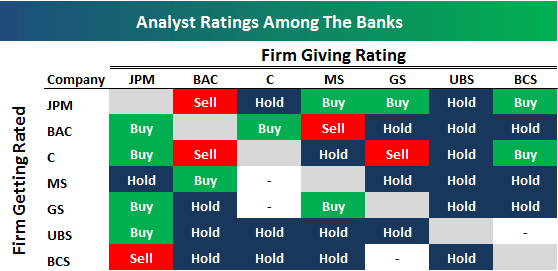
JP Morgan (JPM), Citi (C), Bank of America (BAC), Morgan Stanley (MS), Goldman (GS) and UBS. Analyst ratings on fellow banks as at 28 January 2009. Knowing analysts' ratings, a SELL is a big sell, a HOLD means its a SELL as well.

This will not just be in the US but will affect a few of the top banks in Europe as well. The idea of a bad bank is basically an alarm bell to all that TARP as it is will be insufficient to bailout the big banks. We now cringe at the size of the TARP and Obama's stimulus package, well how about another $1.5 trillion for the bad bank - while that is good for the markets, it should be the death knell for USD.


p/s photos: Chen Run Xi


Its In The Price, Baby!


Things we know, some pretend experts will always say "its in the price". Is it really in the price already? Stock markets are forward discounting models, hence it would be silly to think that any known news would not be in the price already.

So when the banks started falling like bricks, markets fell. But when Lehman Brothers was allowed to fail (Paulson's gravest mistake), that was akin to saying all bets are off, that no one was big enough not to fail. That is why, in many ways, the collapse of Lehman Brothers paved the way for extreme risk aversion. Investors were calmed when AIG was rescued, followed by Fannie and Freddie. However when Lehman Brothers were allowed to fail, investors realised that other troubled entities might not be rescued.

Having realised his mistake, Paulson and Bernanke basically set about rescuing everything they could. Well, not everything, but every big thing. So, when something's in the price, it depends on the logical chain of events that follow - if that's the case, then its in the price. When something out of the ordinary pops out, then its not really in the price yet.

Markets globally collapsed by between 40%-60% over the last 13 months. One can say its in the price, right?! Well, yes and no. The fall is discounting the recession that will be pervasive. While earnings is expected to be bad, no one is certain how bad and for how long. While there have been extreme fiscal measures by most governments, investors will want to see the execution and implementation are done speedily and effectively (not drawn out over 2-4 years).

The markets was priming itself for a bear market rally stepping into the new year, but was halted by rumours of worse than expected losses by some major entities, e.g. Deutsche Bank, HSBC, Bank of America (having problems digesting Merrill Lynch) and Citigroup. The biggest factor has to be Citigroup as it was not just bad earnings but rather whether the entity will even exists. The losses for the latest quarter was not as bad as the rumoured $10bn. Still, steps have been taken to shrink itself down, so markets are calmed somewhat.

Of more importance was Bank of America. The company just received another $20bn to ease their absorption of Merrill Lynch. So far, they have received $138bn in government aid. What is more noteworthy is that their market cap is only approximately $50bn. Technically speaking, you might as well fold it and restart 5 new banks with the $138bn. However, its not as simple as it looks. Allowing Bank of America to fail is not just wiping out $50bn in market cap, it will also trigger a domino effect of counter party transactions failing. The ramifications which could erase more than ten or twenty times the $50bn Bank of America is worth. The confidence issue will take much longer to return should that happen.

Jim Rogers and those market purists will argue that the weak should be allowed to fail, and that no one should be too big to fail. But the reality does not allow for textbook style economics to be implemented. There is the bigger picture to consider - governments have to contend with the aftermath and flow on effects. You may be able to handle a10% unemployment rate, but what if it escalates to 20%, the social costs will be too great. You may even have to go to war to keep employment up.

Markets have fallen 40%-60%, so some of the recession and poor earnings have been factored in the price. Whether the markets have priced in all is debatable. I am of the minority group viewing that the markets have more than priced in the decimation in demand, poor earnings, company failings (look at the yields on non-prime corporate bonds) and jobs losses. To be sure, I think job losses will continue to worsen and may only peak in March/April, and till then I expect even a few more big companies failing ala Nortel and possibly Motorola. Though not publicised, already more than a few hundred small regional banks and mortgage firms have already closed sop in the US. My biggest argument why the markets have over-discounted the weakness is the absolute non-existence of confidence, and the extreme risk aversion to assets of almost all types. The de-leveraging basically just sped up the entire process. have you see how fast and hard commodity prices and shipping rates have collapsed. This is not a slow death, it is a swift reaction, anything seemingly left standing got its head chopped off, within or without reason.

The committment by the Treasury in the way it is treating Bank of America and the likes shows that they will not let another big entity fail. While many will be pooh-poohing Obama's $1 trillion stimulus, saying that its in the price... come to think of it, its not really in the price considering the markets were at the same level it was 2 months back when Obama wasn't even elected??!! Why do they say its in the price? Its the bear's normal reaction - give me anything, give me any news... I will say the good news will be in the price already, and the bad news that appears are not properly discounted yet. Give the bears any news, it will be considered as in the price already for sure.

I am not saying the bears are totally wrong, but one must view the developments with a proper view of developments. All it takes is just a minor improvement in risk aversion and confidence, and you will find things moving quite fast already. Looking at the markets for the last 2 days, even when the Dow flirted with the dubious 8,000 level... there was sellers' exhaustion. I am not trying to talk you all into believing all is right with the world, but that its not as bad as things seem.

p/s photos: Haruna Yabuki

What Should Happen & What Is Likely To Happen


General Motors

What Should Happen
- Allow the company to go into Chapter 11 or what we call bankruptcy. Then the company will have real negotiation leverage and the unions will really have to listen and make concessions. The government can then step in with some funding but call the shots. Force the merger of General Motors and Chrysler. All outstanding car warranties will be guaranteed by the government via a separate vehicle. Following huge concessions made by the union, the selling down and dismantling of parts, the reworking of cost savings with the 2 companies... maybe, just maybe they can survive.


What Is Likely To Happen
- Democrats will probably approve a US$25bn bailout when they return on December 8, but a viable plan is expected from the automakers. Expect Chrysler to quicken talks with GM to hash a merger to get the US$25bn bailout plan approved. Short term feel good, but without bankruptcy, the unions and their demand swill stay the same. Its the liabilities and claims by employees on the company's balance sheet which will always bring the company down. The lifeline will give then a few months grace but the end result is bankruptcy.
The trouble is that with the US$25bn bailout, the unions will not lower their rights and demands... you need to put the company into bankruptcy to leverage your negotiations. Sink or swim.

Citigroup


What Should Happen
- JP Morgan or Morgan Stanley should step up to buy Citigroup, with the Treasury guaranteeing maybe US$30-50bn in losses. That will calm markets. Its not likely Citi will be able to remain independent for long on its own. The amount of toxic assets is US$80bn, and we haven't even looked at the fallout on funds being tied to Lehman Brothers. Citigroup has another shoe to drop, credit card debts, which will implode as well. A merger would see a bid of at least US$20 per share. It will further reduce counterparty risks in dealing with Citigroup.


What Is Likely To Happen
-
The company will be taken over by FDIC to prevent a bank run, especially from global depositers. Their liquidity ratios are seriously questionable at this point. The result would be a total break-up of the group. JP Morgan may still end up with the commercial banking side in a break up sale. As Citigroup is trading at barely 1/4 book value, a break up sale should see at least a US$10 value to its shares.

Other Potential "Bad Developments" In Coming Weeks & Days

a) GMAC running into deep trouble.

b) GE Capital running into deep trouble.

c) The merger between Bank of America and Merrill Lynch running into problems owing to ML's excessive exposure to toxic assets.

d) Nobody steps in to help Citigroup, and this time global effects will be felt as Citi's exposure is more pervasive globally.

e) Markets switch to look at credit cards implosion, dragging Citigroup and Amex into deeper trouble.

Still, we are seeing possibly the "peak in selling" here, expect 7,000-7,300 to be attract strong buyers for the longer term and should hold up well there. Asian markets should find good buying support now as there is almost zilch holdings by foreign funds - nothing left to sell now literally. Its not hunky-dory, but those with at least a 6 montn view may nibble.


p/s photos: Li Bing Bing