Showing posts with label Nationalisation of banks. Show all posts

The Fate of Bank of America


Bank of America is being sold down as if its going to zero. Owing to the volatility, that forces many pundits to take a stand on the stock. If you believe it will survive, the share price at $4-$6 is very attractive. If you believe it will be nationalised, then basically it will be going to zero. The bets are huge, the opinions given will make or break many funds' positions.

Bank of America's stock is now selling at 0.28x expected 2009 revenues; 6.9x expected 2009 earnings; 0.19x stated book value; 0.50x tangible book value. Its market capitalization is 3.4% of its total deposits and 1.7% of its assets. These numbers are clear, investors believe that this bank is about to fail and be nationalized by the United States government. If they believed that it would continue as an operating entity it is unlikely that the bank would be selling at such a low value. Generally, with such numbers staring at your face, it will be difficult to think the bank is insolvent.

Those on the sell side:

a) One reason for this conviction, on the part of investors, is Bank of America's acquisition of Merrill Lynch. It is felt that either the company did not do the appropriate due diligence before making this acquisition, or that the company lacked the ability to understand how bad Merrill's problems were. In either case a lose/lose situation.

b) Management is now fighting back. In an article in today's Wall Street Journal it is reported that the United States coerced Bank of America into buying Merrill against management's will. This article could only have come from an interview with Bank of America's management. The point to investors is "we knew what was going on but we had no choice." That serves no purpose other than to absolve management of BoA from the Merrill Lynch acquisition. Not good PR, and a hint of things to come. This, to some extent, alleviates the questions concerning management's competence. It does not take away the belief on the part of investors that the company's woes are so significant that it will fail.

Those on the buy side:

a) The fears does not make sense. In the fourth quarter, Bank of America's deposits rose by almost a net $9 billion. Its loan loss provision was $8.5 billion but 27% of this was a reserve build and the whole amount was a non-cash charge. It took close to $8 billion in losses related to securities. The portion that was non cash in nature may have been as high as 75%.

b) The point is that this bank is cash flow positive. The danger of failing is exaggerated. Plus, the United States is now committed to keep it in business.

My view is that all things being equal, when selling is so concentrated, it is always better to err on the side of caution. Some things are better not to bet on even on the potential of a big payout. BoA is no small thing, it is the biggest thing the US government has left to save on. BoA has already received $45 billion of TARP money. Prior to receiving the bailout funds, its market cap was $159 billion. Now it is less than $30 billion. Obviously something is very wrong. It is certainly not a short selling thing anymore.

This experience would serve all investors very well, when something looks too good to be true (i.e. BoA going on very cheaply), it probably is. The trick is to try and find the pink elephant in the room. How can so many miss the pink elephant? How can BoA, seemingly one of the healthier banks, one that even had the audacity to buy Merrill Lynch and Countrywide just a few months ack when all banks and mortgage companies were collapsing right-left and centre.

The price is always right, and there are always people who will have some additional information than the rest. You just have to do more homework. If BoA did not buy Countrywide and Merrill Lynch (particularly the latter), it would not have to come to this. Obviously the management is at fault.

The problem is BoA's lack of capital. BoA has been on the forefront in share buybacks. Since 1998 it has bought back $62 billion in shares thus reducing its tangible capital ratio. Back in 1998 BoA's capital was 5%, now it stands at just 2.8%. At that level, it is very easy to see the capital being completely wiped out, especially when you look at the toxic assets under Merrill Lynch. The TARP funds does not add to the banks' capital. BoA was forced to write down $4.4 billion in the latest quarter, or 1.8% of its loan portfolio. But that whittled down BoA's capital down to 2.6%. Thats way much weaker than even Citigroup.

For Bank of America the key figure is the fact that the bank only had $1.3 billion of reserves tied to $255 billion in first lien mortgages or about 0.56%. Such a low reserve amount is shocking and will likely be the point by which Bank of America faces the worst pain going forward. The bank’s total managed consumer portfolio was better, yet still only had reserves of 2.83% on a $694 billion portfolio. In addition, its total commercial portfolio of $380 billion only had reserves amounting to 1.96%. If unemployment were to peak at 9%, you can see that there will be substantive writeoffs over the first two quarters of 2009, which will see the reserves and capital adequacy elements being wiped out. On those areas, BoA is in the worst shape among the big banks, even worse than Citigroup, a lot worse off.

Put in another way, Bank of America has assets of $1.836 trillion and derivatives of $39.979 trillion, (mostly swaps). With the demise of the Shadow Banking System (non bank financial institutions), trading derivatives is much more difficult. If marked to market, one wonders just how much of a loss would be realized in this $39.979 trillion portfolio. Nobody, who will talk about it anyway, seems to know. It wouldn't take much to wipe out $1.8 trillion in assets.

Buying Merrill Lynch did boost BoA's capital but Merrill also reported a $15 billion loss in 4Q, which prompted BoA to ask for an additional $20 billion in TARP funds ontop of the earlier $25 billion. Plus it got a $100 billion in guarantee from the government. BoA is now hinging on the 'bad bank' idea, which will buy up the toxic assets at a premium. But the bank needs it quick. Chances are it will not be easy to start the 'bad bank' idea as even the $800 billion stimulus plan is facing hurdles just to get it past the lawmakers.

The 'bad bank' idea needs at least $2 trillion to start with. How do you think that will go down with the Congress and Senate? Geithner may be doing a a twist to the bad bank idea, in that the fund may not be buying the toxic assets but will give a kind of guarantee or insurance on the value of the assets. If the toxic assets are now at 40% of value in the banks' books, the fund could guarantee that if values dropped below 30%, the losses will be borne by the fund. That way, it will put a bottom number to the amount that the banks will have to write down. That will be a big comfort as investors do not know how low these assets could go to. This way, they know the bottom, and the fund does not end up buying the toxic assets. If that eventuate, its good news for the banks.

Still, BoA is most in danger. Watch closely if any of the top management of BoA are leaving the company - if they are then its nationalisation, baby.


p/s photos: Meisa Kuroki


Why Citibank Might Not Be Around ... Soon


Why pick on Citibank? Didn't they agree to break up the company already? Well, one can argue that the biggest toxic assets reside in Citigroup, Lehman Brothers and Merrill Lynch. We all know Lehman was hung out to dry. Merrill's woes are now part of Bank of America's problems. BoA may or may not be able to digest Merrill's positions. Both Citi and BoA have been given tons of money by the US government. Will it be sufficient? In the past 12 months, taxpayers, sovereign wealth funds and private investors have sunk $1 trillion into failing U.S. and British financial institutions, while central banks have slashed their cost of funds to nothing and their collateral standards even lower.

It looks likely that the hole is simply too big to fill even by governments. Bank losses from the write-offs of bad loans and busted derivatives tally up to $1.5 trillion so far. In addition, $5 trillion to $10 trillion worth of off-balance-sheet businesses such as structured investment vehicles - leveraged lending vehicles used by big banks are being forced back to banks' balance sheets by regulators. Rules require banks to keep a base of real shareholder capital amounting to 10% of those funds. So banks need to find up to $1 trillion within the next year to meet that objective.That is in addition to all that has been injected into banks so far.

Add the $1.5 trillion in losses to $1 trillion in needed new reserves, and you can see that banks need as much as $2.5 trillion in new capital to remain solvent under current rules. Consider that the entire world banking system had only $2 trillion in shareholder capital in 2007, before everything blew up. Therefore, the entire system is simply insolvent, as liabilities are greater than assets. Governments aren't forcing banks to admit this, but investors are, and that is why big banks' shares are only a fraction of their value this year compared to their highs in 2008.

Governments, meanwhile, are trying desperately to help banks plug the gap, but they're coming up short. When you add the $500 billion from sovereign wealth funds to the $500 billion from the first tranche of the Troubled Assets Relief Program, it's only $1 trillion. That's already been provided. So that leaves a gap of $500 billion to $1.5 trillion. That's why Trichet said that banks don't need to keep 10% capital reserves.

Is this all priced in? Well, insolvent banks is why credit is not flowing, besides being a confidence issue as well. Even BoA and JP Morgan Chase are continuing to drop despite being on firmer ground. Investors have already factored in the likely outcomes. Nationalise (take over) Citibank, and force a merger with either BoA or JP Morgan Chase. Nationalisation means that banks would have to issue equity to the government, a process that wiped out current shareholders. Yes, that would mean most bank stocks would go to zero. If banks are insolvent, the most attractive asset they have is the brand. To leave them hanging around means they won't be able to do any lending, just like zombie firms. The new administration will have to bite the bullet on this. When this happen, it will be viewed as a positive, not a negative, as we will be on our way to cleaning up the zombies.

To be clear, when I say that Citibank and/or BoA might not be around soon, it basically means that they will be absorbed into another entity, not that they will disappear or that their jobs will disappear. The best that the big banks can hope for is that the 'bad bank' idea takes root - but they will have to ask for another $1.5 trillion to fund the 'bad bank', if that takes flight, then Citigroup, BoA and the rest can sell the toxic assets to the 'bad bank' ... then they can still survive, if the 'bad bank' idea fails... its nationalisation , baby...

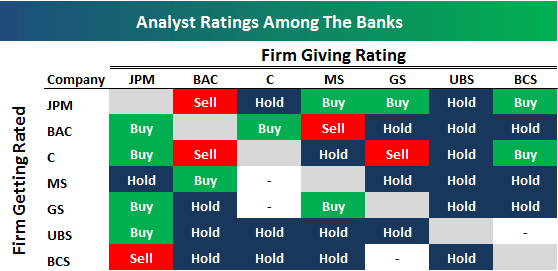
JP Morgan (JPM), Citi (C), Bank of America (BAC), Morgan Stanley (MS), Goldman (GS) and UBS. Analyst ratings on fellow banks as at 28 January 2009. Knowing analysts' ratings, a SELL is a big sell, a HOLD means its a SELL as well.

This will not just be in the US but will affect a few of the top banks in Europe as well. The idea of a bad bank is basically an alarm bell to all that TARP as it is will be insufficient to bailout the big banks. We now cringe at the size of the TARP and Obama's stimulus package, well how about another $1.5 trillion for the bad bank - while that is good for the markets, it should be the death knell for USD.


p/s photos: Chen Run Xi


Markets Can See Some Catalysts


US lawmakers are likely to hand Barack Obama the first major win of his week-old presidency on Wednesday, overriding chiefly Republican objections to pass an US$825-billion economic stimulus plan. The US House of Representatives was expected to approve the package, a centerpiece of Mr Obama's efforts to resurrect lost US jobs and kickstart stalled US growth, in the late afternoon or early evening largely along party lines. Key US Senate committees have begun shaping their chamber's version of the bill, as Democrats and the White House say they hope to speed the final measure through the US Congress and to the White House by mid-February.

The House vote was to come one day after the Democratic president made his first work visit to the capitol, wooing defiant Republicans with closed-door assurances that he hears their complaints and shares some of their worries. 'Nobody is more worried about the deficit and the debt than me. I will be judged by the legacy I have left behind,' Obama told House Republicans. The appeal came hours after Republican leaders, looking for more tax cuts and less spending, directed their troops to oppose the Democratic bill, which provides about US$550 billion in spending and US$275 billion in tax cuts.

Publicly, Mr Obama said he recognised 'legitimate' Republican gripes with his approach but argued waves of jobs losses and punishing economic news dictated urgent action and not political gamesmanship. 'I don't expect one hundred per cent agreement from my Republican colleagues,' Mr Obama said as fevered political maneuvering on Capitol Hill contrasted with the euphoria of his inauguration there a week before. 'But I do hope that we can all put politics aside and do the American people's business,' the president said in a time-honored appeal for Washington to overcome its bitter partisan divisions. Mr Obama may need Republican support for political cover if the stimulus plan, now widely popular with the US public, fails to achieve its sought-for effects.

The president wants thumping congressional majorities for the stimulus, the first big test of his presidency, to give him momentum for other priorities and to make good on his vow to be a bipartisan leader. Republicans lack the votes to defeat the stimulus bill on their own, but could slow its progress, especially in the Senate. The Congressional Budget Office estimates that $169 billion of the $825 billion in stimulus will hit the economy before the end of September and that the bulk of it will show up in 2010 and 2011. - AFP
--------------------------------------------------
WSJ: A measure to allow judges to reduce the principal amounts of mortgages for troubled borrowers in bankruptcy cleared a key hurdle Tuesday when it was approved by a U.S. House panel. The legislation, which is progressing quickly in Congress, would amount to the most aggressive step yet by the federal government to help strapped borrowers avoid foreclosure. Proponents contend it will act like a stick, spurring mortgage servicers to complete more loan modifications. Meanwhile, the banking industry warns that it will raise mortgage costs for all borrowers.

The measure was approved on a 21-15 vote after its House sponsor, Judiciary Chairman John Conyers, D-Mich., agreed to changes that would narrow its scope. "While bankruptcy reform may not provide all of the answers to this crisis, surely it provides a common sense and practical approach to helping stop the spiral of home foreclosures," Conyers said in remarks before his panel.

Under the legislation, borrowers would be eligible to have a bankruptcy judge reduce the principal balance on their home loan - a move known as a "cram down." Current law allows cram downs for mortgages on vacation properties, but not for those on primary residences.

-----------------------------------------------------
CNBC: A Senate committee approved $342 billion in tax cuts on Tuesday as part of a larger plan to stimulate the economy. The Senate Finance Committee voted 14 to 9 to approve the legislation after amending the original proposal to make sure middle-class taxpayers aren't hit by the alternative minimum tax this year. All Republicans on the committee opposed the package except for Sen. Olympia Snowe, R-Me. The bill includes a $500 individual tax credit, tax breaks for businesses to hire workers and buy equipment, and tax incentives for energy efficiency.
------------------------------------
In Tokyo, the Nikkei Stock Average climbed 4.9% to 8061.07 Tuesday, also getting a boost from the Ministry of Economy, Trade and Industry, which said it is considering a plan to provide public funds to companies beyond banks that have been hardest hit by the financial crisis. The fact that governments are beginning to look beyond the banking sector to revive the economy is a major step to begin to understand the gravity of the issues.
----------------------------------------------------
The biggest catalyst has to be the report that the government is creating a plan to buy up toxic assets from firms in an effort to stabilize the shaky banking system. What that means is that there will probably be a person in charge mediating on the price to buy off the toxic assets from the banks. Right now, no private funds are willing to buy as there is no certainty on the price. This is the 'bad bank" plan, the bad bank will end up with the toxic assets. In reality we are going via the RTC method whereby we are consolidating the toxic assets, we are just ONE step shy of nationalising some of the banks - which may not be a bad thing. In fact, if Geithner takes the nationalisation path, I am certain the markets would rise further.

p/s photos: Sara Malakul Lane


Pounding The Pound


The fall in value of the British pound is a problem for mainland Europe and will be added to regular talks on exchange rate issues when G7 finance ministers meet in February. In the past year, sterling has lost around 30 percent versus the dollar, 20 percent versus the euro and more than 40 percent versus the yen. Late Wednesday, the pound bounced back to $1.3977 after slipping to a 23-year low of $1.3618. The British pound has fallen to a 7-year low against the US dollar and a record low against the Japanese Yen.

Bank of England Gov. Mervyn King on Tuesday night signaled that the central bank was set to seriously consider buying up a range of assets in coming weeks in an effort to jumpstart stalled lending to businesses and households. He also outlined potential "quantitative easing" measures that could be used to boost the money supply, or effectively print money, in the face of a steep contraction that threatens to take inflation below the central bank's 2% inflation target. The market is afraid that the UK will turn into the next Spain or Greece. Over the past few months, they have been working overtime to inject more stimulus into the economy, but the more that they spend, the worse impact it has on the UK’s fiscal position. Deteriorating public finances has been the primary motivation for the recent downgrades of sovereign debt ratings by Standard and Poor’s. The FSA has dismissed this rumor but that doesn’t mean that the UK can’t be put on credit watch negative which would be one step before a downgrade.

Investors are selling now and asking questions later because a downgrade would mean more losses for the British pound. Whenever a country loses its AAA rating, funds that are mandated to invest in only AAA assets need to liquidate and shift their positions elsewhere. We have seen this with Spain and could see it again with the UK.

Data from the U.K. labor market showed December jobless claims rose by 77,900, while November claims were revised up to show an increase of 83,100 from an initial estimate of 75,700. The U.S. and the U.K. face very similar predicaments, from a deepening recession to a damaged financial system. Both are orchestrating massive bank bailouts and attempting to assist struggling homeowners. Both are ramping up government spending even as they rely on financing from overseas investors. And both countries have central banks that have slashed interest rates and opened the door to unconventional ways of stimulating the economy.investors not only dumped the pound earlier this week, but also shed U.K. stocks and government bonds, sending their yields up. Such a combination, if sustained, would raise the fear that investors are exiting from a host of U.K. assets, creating a vicious cycle that is difficult to arrest.

Investors worry that Britain could end up fully nationalizing more of its banks, adding more pressure on its balance sheet. It already owns 43% of Lloyds and 70% of Royal Bank of Scotland and nationalized lenders Northern Rock PLC and Bradford & Bingley PLC last year.


After a steady weakening in value for most of 2008, it looks like the British pound will be in for continued weakness for at least the first half of 2009. The problems with UK are very similar to the US. But the similarity ends there - pound got trashed but the USD found strength. They both had the unholy economic trinity of problems - high debt, property prices, an overvalued currency. However, the thing that puts the UK on a different plane:


a) UK property prices has been on a more massive over-valuation compared to the US property


b) at least the USD is a reserve currency still, a luxury buffer the British pound does not have


c) the UK is not using the euro, which may offer some protection by being in a grouping, there is very little incentive for any groupings to help out the pound, in fact the entire chain of events may make the UK to hasten the process to adopt the euro... you didn't want to adopt the euro before because of the perceived strength of the pound and the need to have monetary independence, now in extreme weakness, the UK may have little choice but to take on the euro to replace the increasingly decimated value of the pound


d) in terms of debt, US consumers have loaded up on property financing and credit card debts, the situation is not dis-similar in the UK


e) the credit crisis which decimated banks capital in the US is reflective of many UK institutions as London rivals New York in terms as international finance centers, hence the mode of operations and exposure are very similar as well


All said, the British pound should make new lows in the coming weeks and months. Nationalising of banks will be a hot topic in both US and UK. Talks of adopting the euro and dumping the pound will take on greater fuel.


p/s photos: Elanne Kong Yuk Lam

Bashing Conservatives, Nationalising The Banks

by Paul Krugman

Wall Street Voodoo Economics

Published: January 18, 2009

Old-fashioned voodoo economics — the belief in tax-cut magic — has been banished from civilized discourse. The supply-side cult has shrunk to the point that it contains only cranks, charlatans, and Republicans.

But recent news reports suggest that many influential people, including Federal Reserve officials, bank regulators, and, possibly, members of the incoming Obama administration, have become devotees of a new kind of voodoo: the belief that by performing elaborate financial rituals we can keep dead banks walking.

To explain the issue, let me describe the position of a hypothetical bank that I’ll call Gothamgroup, or Gotham for short.

On paper, Gotham has $2 trillion in assets and $1.9 trillion in liabilities, so that it has a net worth of $100 billion. But a substantial fraction of its assets — say, $400 billion worth — are mortgage-backed securities and other toxic waste. If the bank tried to sell these assets, it would get no more than $200 billion.

So Gotham is a zombie bank: it’s still operating, but the reality is that it has already gone bust. Its stock isn’t totally worthless — it still has a market capitalization of $20 billion — but that value is entirely based on the hope that shareholders will be rescued by a government bailout.

Why would the government bail Gotham out? Because it plays a central role in the financial system. When Lehman was allowed to fail, financial markets froze, and for a few weeks the world economy teetered on the edge of collapse. Since we don’t want a repeat performance, Gotham has to be kept functioning. But how can that be done?

Well, the government could simply give Gotham a couple of hundred billion dollars, enough to make it solvent again. But this would, of course, be a huge gift to Gotham’s current shareholders — and it would also encourage excessive risk-taking in the future. Still, the possibility of such a gift is what’s now supporting Gotham’s stock price.

A better approach would be to do what the government did with zombie savings and loans at the end of the 1980s: it seized the defunct banks, cleaning out the shareholders. Then it transferred their bad assets to a special institution, the Resolution Trust Corporation; paid off enough of the banks’ debts to make them solvent; and sold the fixed-up banks to new owners.

The current buzz suggests, however, that policy makers aren’t willing to take either of these approaches. Instead, they’re reportedly gravitating toward a compromise approach: moving toxic waste from private banks’ balance sheets to a publicly owned “bad bank” or “aggregator bank” that would resemble the Resolution Trust Corporation, but without seizing the banks first.

Sheila Bair, the chairwoman of the Federal Deposit Insurance Corporation, recently tried to describe how this would work: “The aggregator bank would buy the assets at fair value.” But what does “fair value” mean?

In my example, Gothamgroup is insolvent because the alleged $400 billion of toxic waste on its books is actually worth only $200 billion. The only way a government purchase of that toxic waste can make Gotham solvent again is if the government pays much more than private buyers are willing to offer.

Now, maybe private buyers aren’t willing to pay what toxic waste is really worth: “We don’t have really any rational pricing right now for some of these asset categories,” Ms. Bair says. But should the government be in the business of declaring that it knows better than the market what assets are worth? And is it really likely that paying “fair value,” whatever that means, would be enough to make Gotham solvent again?

What I suspect is that policy makers — possibly without realizing it — are gearing up to attempt a bait-and-switch: a policy that looks like the cleanup of the savings and loans, but in practice amounts to making huge gifts to bank shareholders at taxpayer expense, disguised as “fair value” purchases of toxic assets.

Why go through these contortions? The answer seems to be that Washington remains deathly afraid of the N-word — nationalization. The truth is that Gothamgroup and its sister institutions are already wards of the state, utterly dependent on taxpayer support; but nobody wants to recognize that fact and implement the obvious solution: an explicit, though temporary, government takeover. Hence the popularity of the new voodoo, which claims, as I said, that elaborate financial rituals can reanimate dead banks.

Unfortunately, the price of this retreat into superstition may be high. I hope I’m wrong, but I suspect that taxpayers are about to get another raw deal — and that we’re about to get another financial rescue plan that fails to do the job. January 19, 2009, 10:24 am

Economists, ideology, and stimulus

There are certainly legitimate arguments against spending-based fiscal stimulus. You can worry about the burden of debt; you can argue that the government will spend money so badly that the jobs created are not worth having; and I’m sure there are other arguments worth taking seriously.

What’s been disturbing, however, is the parade of first-rate economists making totally non-serious arguments against fiscal expansion. You’ve got John Taylor arguing for permanent tax cuts as a response to temporary shocks, apparently oblivious to the logical problems. You’ve got John Cochrane going all Andrew-Mellon-liquidationist on us. You’ve got Eugene Fama reinventing the long-discredited Treasury View. You’ve got Gary Becker apparently unaware that monetary policy has hit the zero lower bound. And you’ve got Greg Mankiw — well, I don’t know what Greg actually believes, he just seems to be approvingly linking to anyone opposed to stimulus, regardless of the quality of their argument.

Needless to say, everyone I’ve mentioned is politically conservative. That’s their right: economists are citizens too. But it’s hard to avoid the conclusion that all of them have decided on political grounds that they don’t want a spending-based fiscal stimulus — and that these political considerations have led them to drop their usual quality-control standards when it comes to economic analysis.

Has there been any comparable outbreak of mass bad economics from good liberal economists? I can’t think of one, although maybe that’s my own politics showing. In any case, what’s happening now is pretty disturbing.

p/s photos: Zhou Wei Tong